


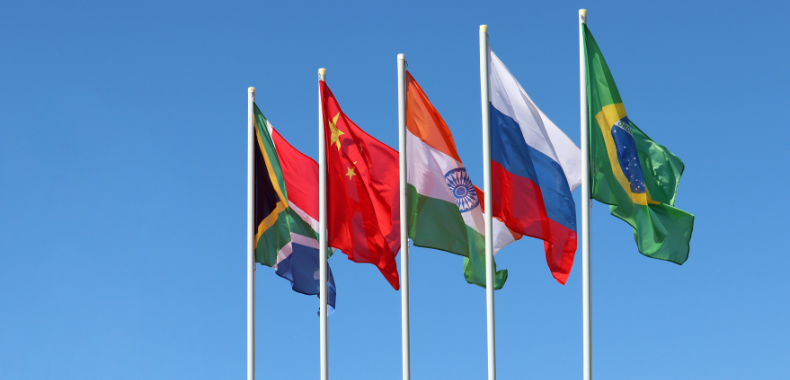
Brazil, Russia, India, China, and South Africa’s representatives (a.k.a. BRICS) have recently met and discussed numerous topics related to the implementation and use of artificial intelligence to equalize and provide inclusive governance among all countries.
Numerous topics were addressed, such as the ethical use of Artificial Intelligence, access to new technologies, the implementation of data governance, respect for each country’s national sovereignty etc. In addition, the statement also addressed the protection of intellectual property, more specifically, copyrights of authors whose data is used without authorization in the generation of works created by AI.
On its statement, BRICS defends the need for an adequate definition of copyright protection, taking a stand against the unauthorized use of AI in the generation of works, to combat abusive data extraction and privacy violations, allowing for fair remuneration mechanisms.
This issue is quite topical and has generated controversy in the intellectual property community around the world, mainly due to differences in what is understood to be copyrighted works. In Brazil, for example, a work is considered copyrighted if it originates from what is known as “creations of the mind,” that is, a human creation of a particular work, such as art.
Thus, Brazilian legislation takes a more conservative approach to the issue, leaving no room for understanding the copyright protection of works generated from AI, since, when interpreting Brazilian law, it is understood that anything that is not a human creation cannot be protected by copyright. In contrast, other countries such as China takes a more comprehensive approach, allowing AI-generated works to be eligible for copyright protection.
These examples demonstrate the delicate, current, and uncertain nature of copyright protection in relation to works generated by AI. That said, it is extremely important for a politically relevant group such as BRICS to speak out on the subject, especially when it is possible to observe that there are differences in their internal legislation, as we mentioned with Brazil and China.
Although it was a brief and superficial analysis and perception of the topic, the statement is valid and may generate other public statements from other political and economic groups, which will be responsible for promoting new definitions on the subject, as well as standardizing what the international community recognizes, facilitating understanding not only among experts, but also among the community as a whole.
Accordingly, the publication of the opinion provided by the aforementioned group is of utmost importance, revealing the concern of each of its members, including Brazil, with the equalization of the use of new technologies, as well as the protection of previously acquired rights, maintaining the balance between the development of new tools, but also ensuring that the community will be protected in the exercise of its rights under national and international law.
—
Authors: Maria Eduarda Rodrigues Farias, Lígia Ferreira Marcondes Rocha and Cesar Peduti Filho, Peduti Advogados.
Source: Brics defende governança da IA baseada em Carta da ONU e com respeito a direitos autorais.
—
“If you want to learn more about this topic, contact the authors or the managing partner, Dr. Cesar Peduti Filho.”
“Se quiser saber mais sobre este tema, contate as autoras ou o Dr. Cesar Peduti Filho.”